

Every Basel parent gets the question at some point, usually from a 4-year-old kicking a ball in the kitchen: “Can I play football like the big kids?” The short answer is that five or six is when most children are ready for organised soccer in Switzerland,but readiness matters more than the number on the birthday card, and it’s never too late to start. This guide walks you through what the science says, how the Swiss club system works in Basel, and how to tell whether your child is ready right now.

The short answer: what the science says
The American Academy of Pediatrics is unambiguous: “Before age 6 years, most children do not have the basic motor skills for organised sports. Balance and attention span are limited, and vision and ability to track moving objects are not fully mature.” By age six, those skills click into place for most kids,though hand-eye coordination and the social skills behind teamwork keep developing well into the primary school years.
Swiss sports science arrives at the same answer from a different angle. The federal J+S-Kindersport programme (BASPO) calls ages 5 to 10 the “goldenes Lernalter”,the golden learning age, when coordination, balance, and orientation develop best. Sixty thousand Swiss children aged 5 to 10 play club football every weekend. It’s the country’s single biggest entry point into an active sporting life.
The honest version: five and six are the right starting window for most kids, but the gap between a ready 5-year-old and a not-yet-ready 6-year-old is bigger than the gap between either of them and a 7-year-old. Don’t rush the calendar.
Soccer by age: a stage-by-stage guide
Ages 3-4: play, not soccer
This isn’t soccer yet, and that’s fine. A three-year-old’s “training session” is kicking a ball around the living room with you, or chasing it across a park. Attention spans are about 15 minutes. Group instruction doesn’t work at this age,children play next to each other, not with each other. Skip the structured classes and let them fall in love with a ball at their own pace.
Ages 5-6: the typical starting point
This is when most Swiss children join their first club. The Schweizer Fussballverband (SFV) calls this category G-Junioren, and 2025/26 brings in children born in 2019 or later. Sessions look like organised chaos: 2-versus-2, 3-versus-3, no goalkeepers, no league tables, no winners or losers on paper. Every child has a ball. Cleats aren’t allowed yet (Swiss rules),turf shoes only, shin guards mandatory. BSA’s weekly soccer courses in Basel start at age 5, with a maximum of 12 children per coach.
Ages 7-9: building real skills
Now the building begins. Children can hold attention for 30 to 60 minutes, follow rules, work with a partner. This is when dribbling, passing, first-touch, and basic positions enter the picture. In the Swiss system this maps to F-Junioren (7-8) and E-Junioren (9-10),still small-sided (3v3 to 6v6), still no league standings, but the football gets recognisable. Many kids who join BSA at this age are catching up from a later start, or building extra touches outside their club training. Goalkeepers often discover themselves around now, which is why we offer dedicated goalkeeper training from this age up.
Ages 10-12: tactics and teamwork
Tactical understanding clicks. Children can hold a position, read the field, understand offside. The Swiss D-Junioren category (now split into D-7 and D-9 in the 2025/26 reform) introduces 7v7 then 9v9,a real bridge to the 11v11 game. Training sessions can run 90 minutes. This is also the stage where parents start asking the harder question: is my child serious about this, or just having fun? Both answers are correct.
Ages 13+: competitive development
C-Junioren (U14/U15) play 11v11 on full-size pitches with league tables and proper competition. Athletic development becomes part of the programme,speed, strength, conditioning alongside the football. Some Basel children join the FCB Nachwuchs pathway here, or one of its partner clubs. Others choose academies that focus on individual development without the competitive league pressure. BSA’s High Performance Sports Education Program is designed for committed athletes 11-18, blending technical work with mental performance, nutrition, and leadership.

How it works in Basel: the Swiss club system explained
If you didn’t grow up in Switzerland, the Verein system can feel opaque. Here’s how it actually works in Basel.
Children play in age categories set by the Schweizer Fussballverband: G, F, E, D, C, B, A,from age 5 up to 19. Each category has a fixed birth-year window. In Basel-Stadt and Baselland, the regional association is FVNWS (Fussballverband Nordwestschweiz), and they adopted the new SFV category structure ahead of the national rollout in 2025/26.
Most kids play for a local Verein. BSC Old Boys runs a full Kinderfussball pathway from G-Junioren onwards. FC Concordia (Congeli) has a strong F-E-D pipeline. Both are official partners of FC Basel 1893,together they run “Projekt Team Basel” for the talented FE-12 and FE-13 age groups, with elite scouting feeding into the FCB Nachwuchs-Campus at St. Jakob.
Membership in a Swiss club typically costs CHF 50 to 250 per year, depending on the Verein. Including boots, shin guards, training kit and the first match-day equipment, your first-year total usually lands somewhere around CHF 800 to 1,000. Most clubs offer two or three free Probetrainings before you commit. The season runs autumn (Aug-Nov) and spring (Mar-Jun), with winter mostly indoor.
For expat families, the catch is language. Most Vereine operate in Swiss German, which is great if your child is in a German-language school and fine without your help,but tough if you need to read the WhatsApp coaching group as a parent. That’s where bilingual academies make a difference: we run mainly in English with German support throughout, so the kids stay comfortable and the parents understand what’s being said.
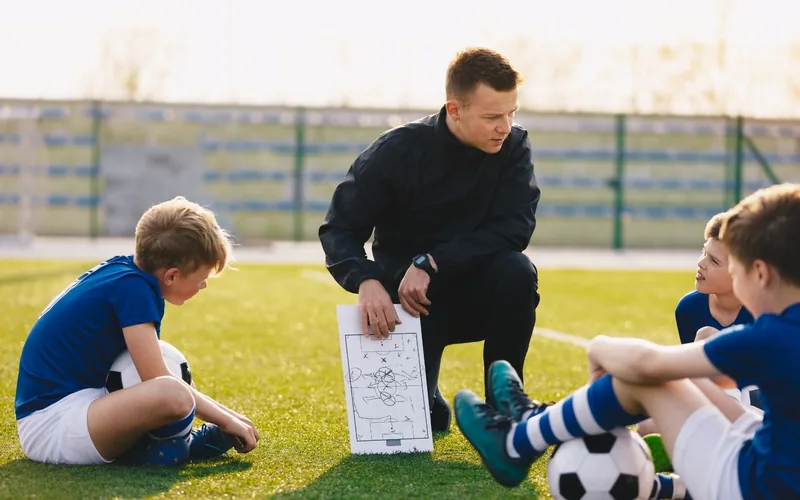
Is my child ready?
You’re not looking for a perfect 5-year-old soccer player. You’re looking for signs that organised group activity, with a coach who isn’t you, is going to work. Five questions:
- Can they take direction from another adult for 30-45 minutes?
- Are they curious about the ball, or only interested when you push?
- Can they follow a simple sequence (“collect the ball, dribble to the cone, pass back”)?
- Are they comfortable being part of a small group of children, even ones they don’t know?
- Do they want to do it?
If most of these are “yes,” you’re ready to book a trial. If most are “not yet,” give it another season. The interest needs to start with the child, not the parent.
Is it too late to start?
No. Plateaus arrive surprisingly early for kids who started at 5 and never moved past the basics,many early starters stall around 12 if they haven’t done consistent individual work. Late starters who train with focus often catch up and pass them. We’ve seen 11- and 12-year-olds join BSA with no prior experience and develop into confident, technical players within a year,usually because they’re old enough to listen carefully, work on their first touch, and own their progress in a way 6-year-olds simply can’t yet.
If your child is 10 or older and just discovering football, private 1-on-1 sessions are the fast track. Small-group training removes the “I’m behind the other kids” anxiety, and ninety minutes of focused work with a UEFA-licensed coach beats months of standing on the edge of a group session.
What to look for in a soccer program
Five things, in order of importance:
- Coach qualifications. UEFA licences (C, B, A, Pro) signal real training, not just enthusiasm. UEFA B is the standard for serious youth coaching.
- Coach-to-child ratio. Under-7s need small groups,no more than 8-10 per coach. Older kids can manage up to 12-15.
- Session length appropriate to age. Thirty minutes is plenty under 6. Sixty minutes from age 6 to 9. Ninety from 10 up.
- Language of instruction. Matters most for expats whose child is still learning German.
- Free trial. Every serious provider offers one. If they don’t, walk away.

How BSA fits
BSA Soccer Academy has been running in Basel since 2016. Our weekly group courses cover ages 5 to 15 at three venues,Friday afternoons at Drisselweg Field in Binningen, Saturday mornings on the synthetic turf at Schützenmatte, and Sunday mornings at St. Jakob’s sports grounds. Our coaches hold UEFA licences and come from seven countries,sessions run mainly in English with German support whenever it helps.
For children who’d rather not start in a group, private 1-on-1 sessions are ninety minutes with one coach and one child, focused on whatever needs work,first touch, finishing, or just confidence on the ball. Many parents use the private route as a stepping stone before joining a Friday or Saturday course.
If you want to test the waters without committing to a term, BSA’s holiday camps run during every Basel school break,Frühlingsferien, Sommerferien, Herbstferien, Sportferien. Full days, half days, or single days; all camps at Schützenmatte. Many of our regular course families started with a single camp day to see if their child liked it.
Every program offers a free trial. Come and give it a try.
Frequently asked questions
What’s the best age to start soccer in Switzerland?
Five or six, at G-Junioren level in a local club, or in a BSA Friday-Saturday-Sunday course. Readiness matters more than the exact age,the AAP says most children are ready by 6, the Swiss J+S programme considers 5-10 the golden window.
Is 3 or 4 too young?
For organised sessions, yes. For kicking a ball around with you in the garden, never. Keep it playful, keep it short, and don’t expect a 4-year-old to follow group instruction.
Is 11 or 12 too late?
No. Late starters often catch up fast, especially with focused private or small-group work. The advantage of being older is concentration,a motivated 12-year-old can learn in three months what takes a 6-year-old a year.
How much does kids’ soccer cost in Basel?
A Swiss club membership runs CHF 50 to 250 per year. Including equipment, your first year typically costs CHF 800 to 1,000. Academy and camp pricing is per course or per week and runs alongside, not instead of, club football.
Do classes have to be in German?
At Swiss clubs, mostly yes,the natural language of training is Swiss German. At BSA, no. We run mainly in English with German support, which works for expat families and for Swiss families who want bilingual exposure.
Can girls play with boys?
Yes, up to about age 12 in mixed teams across Switzerland,and they do. Girls-only options are growing fast: BSA runs a dedicated girls-only camp every summer, and Swiss women’s football boomed after EURO 2025 (hosted in Switzerland, final at St. Jakob-Park).
Club, academy, or both?
Both, if you can. Local Vereine give your child league play and a regular team. Academies like BSA add extra touches, language flexibility, and a try-before-you-commit option. The two are complementary, not competing.
Ready to see if soccer is right for your child? Book a free trial at one of our weekly courses, or try a single day at one of our holiday camps during the next Basel school break. No obligation, no pressure,just an hour on the field with a UEFA-licensed coach to see how your child takes to it.
Sources cited:
– American Academy of Pediatrics,Organized Sports: Is Your Child Ready? (publications.aap.org)
– American Academy of Pediatrics,Organized Sports for Children, Preadolescents, and Adolescents (Pediatrics 143(6):e20190997)
– Swiss J+S-Kindersport, Bundesamt für Sport (BASPO),mobilesport.ch
– Schweizer Fussballverband (SFV) Juniorenkategorien 2025/26,football.ch
– FVNWS Fussballverband Nordwestschweiz,fvnws.ch
– Familienleben.ch,Swiss club cost benchmarks